New to Aussie resumes? Start with the Australian resume format guide. It walks you through the section order, the details to skip and a full worked example.
An Australian Public Service application is a resume plus some writing, judged on merit by a panel.
This guide is about Commonwealth jobs in the Australian Public Service (APS). It leaves out the ACT Government, which hires separately.
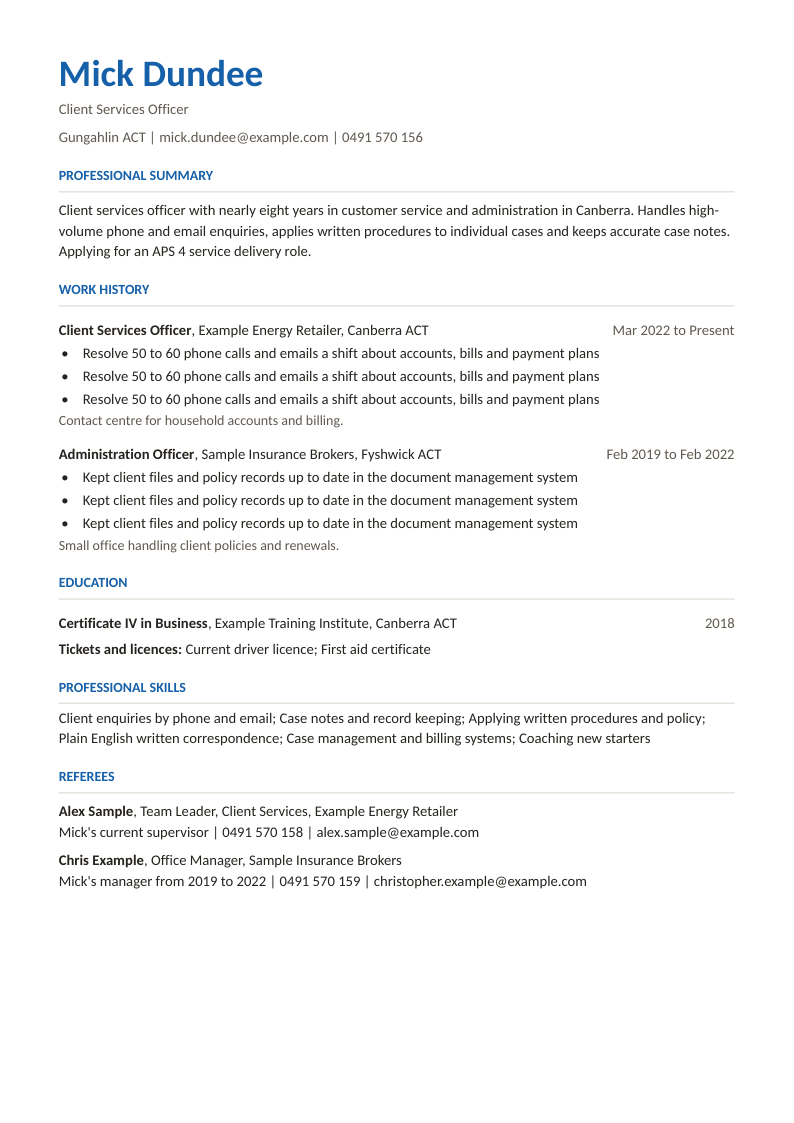
Further down is Mick Dundee, a made-up Canberra applicant, with a resume and a short pitch illustration. For the basics of layout, read the Australian resume format guide and the ATS-friendly resume guide.
How many APS jobs are in Canberra, and why does it come up so much?
At 30 June 2025 the Australian Capital Territory had 70,221 APS employees, which is 35.4% of the service. Victoria came next at 18.0%. A year earlier the ACT share was 36.9%.[1] The Australian Public Service Commission (APSC) publishes new figures each year, so the share may have moved since.
The ACT is the largest single location, and it holds well under half the workforce. The APSC's own guide says Canberra is typically seen as the home of the APS, and that around two-thirds of employees work outside it, in places from Bourke to Geraldton and in overseas posts.[3]
It also says the vast majority of jobs are open to the Australian community.[3] Canberra is the APS's tower on Black Mountain. Everyone spots it first, and most of the service sits well beyond it.
How does APSjobs work, and what do you send?
Righto. The APSC says agencies advertise vacancies in the Public Service Gazette on APSjobs, on their own websites and through other channels. Most agencies run their own recruitment.[3]
The APSC says there's no standard process for filling APS jobs, and the application can vary a lot between agencies and between jobs.[2] Every agency runs its own process, a bit like Canberra suburbs that each name their streets on their own theme.
The ad links to an information pack, and the pack tells you this agency's theme, so read the lot. Its listed items can include some or all of these.[4]
- A cover sheet.
- A resume.
- A statement or pitch about how you meet the job requirements.
- Answers to selection criteria or questions, if included.
- Contact details for referees.
Follow the pack if it sets a length.
What are a pitch and selection criteria, and how do you answer them?
A pitch is a single general statement about your skills, abilities and experience for the job. Selection criteria are a list of qualities and skills, and the agency may ask you to answer each one separately.[4] Limits vary. The APSC mentions 1 or 2 pages and a 1,000 word cap, so follow your pack.[4]
Saying "I communicate well" is like a cockatoo screeching that it's a bird. Everyone hears it and nobody learns a thing. Give the panel evidence instead. We reckon 4 moves cover it.
- Open with the situation: where you worked and what needed doing.
- Say what you did yourself, with the verbs in the first person.
- Give the result, with a number or a date if you have one.
- Close by tying it to the job in the ad.
The APSC mentions the STAR model, which splits an answer into situation, task, actions and results.[4] Draw examples from work, study, volunteering or community roles.[4]
What do APS 1 to 6 and Executive Level mean?
Jobs are sorted into classification levels by the complexity, responsibility and skills involved. The common ones run from APS 1 and 2 up through APS 3 and 4, APS 5 and 6, Executive Level 1 and 2, and the Senior Executive Service.[3] Pay is set by each agency in its enterprise agreement.[3]
How do the Work Level Standards describe each tier?
The APSC's Work Level Standards describe each tier. In our words, from a page last updated 18 December 2024, the pattern is the same all the way up. The more senior the level, the less someone tells you what to do and the more the work depends on your judgment.
APS 1 is routine tasks under close supervision. APS 3 and 4 are straightforward to moderately complex work. APS 5 and 6 add policy advice and independent decisions in your own area. Executive Level 1 and 2 are sensitive, complex jobs with leadership of people or programs.[6]
A job is classified by the highest function it performs on a regular basis.[6]
Check the level before you write, mate, the way a Canberran checks whether an address is north or south of the lake. It tells you where the work sits.
The standards mark out the levels like the markings on a bowls green, and they also sort work into functions such as service delivery and policy. We summarise the standards and quote none of them. The APSC licenses its website under Creative Commons Attribution 4.0 Australia unless noted, and this page is based on APSC content.[10]
What happens after you apply, and how do referee checks work?
The APSC says the principle is merit: from the field of applicants, the agency picks the best person for the job.[2] A panel compares applications against the job requirements and shortlists. Shortlisting can include a phone or video interview, online tests or psychometric testing. An interview, work sample test or assessment centre may follow.[5]
The panel may then contact your referees to confirm your skills and experience, and the APSC says 1 referee is generally expected to be a current or recent supervisor.[5] It also advises noting any sensitivity about contacting a referee, such as one who should be called only if you're in contention.[4]
Ring your referees before you apply and check they're keen to help. A call out of the blue catches a referee like a sprinkler coming on mid-mow, and a flustered referee helps nobody.
Some processes build a merit list, which an agency can use to fill similar vacancies for 18 months from the Gazette advertisement. Other agencies can see your details unless you opt out.[5]
What conditions of engagement can come with an APS offer?
A condition of engagement is a requirement you meet before, or in some cases soon after, you start. The Public Service Act 1999 lists probation, citizenship, formal qualifications, security and character clearances and health clearances as examples, and an agency may add others. Conditions go in the letter of offer.[7]
- Citizenship. An agency head must not engage someone who isn't an Australian citizen unless the agency head considers it appropriate. Citizenship can also be set as a condition. A person who isn't a citizen must be eligible to work in Australia.[8]
- Security clearance. The role sets the level. Baseline covers access up to Protected. Negative Vetting 1 covers Secret. Negative Vetting 2 covers Top Secret. Positive Vetting covers Top Secret including some caveated resources.[9] Read the ad for what applies to that role.
What character, health and probation conditions can apply?
- Character checks. A role can require a character clearance or employment screening, such as a criminal history check. Checks can involve police, licensing boards or past employers.[7]
- Health. A role can ask for a health declaration or a medical examination, and the APSC says decisions must account for the Disability Discrimination Act 1992.[7]
- Probation. Most new employees are engaged on probation, unless the job is irregular or intermittent or a waiver applies.[7]
These are conditions of the job. They sit in the ad, the pack or the offer.
What does a Canberra APS application look like?
Mick is a client services officer from Gungahlin, Canberra. He is applying for an APS 4 service delivery role at an agency he hasn't named, so his summary names the level. The employers, referees and contact details are invented.
Here's a short illustration of the method, written for an invented criterion about applying procedures to individual cases. It tells one story, with the action and the result, and stops, like a good yarn over the back fence. It's invented, so your own pitch should come from your own work.
Criterion (invented): Applies policy and procedures accurately to individual cases.
In January 2026 a customer asked for a payment plan after her hours were cut. I checked her case against the hardship procedure, recorded each step in the case notes and, as the procedure requires, referred the plan to my team leader for approval. She kept to the plan for the next 4 months.
Build a resume Check my resume free
Check yours before a recruiter does.
Upload your resume and see what the hiring software reads. It's free.
Check my resume freeQuick answers
Do I have to live in Canberra to work in the APS?
No. The APSC says around two-thirds of APS employees work outside Canberra, and the ACT held 35.4% of the service at 30 June 2025.
Do I need a security clearance to apply for an APS job?
Some roles need one, and the level is set by the role. The APSC says lacking a clearance must not rule you out of applying if you are willing to undergo one. Check the ad.
Do I have to be an Australian citizen to work in the APS?
An agency head must not engage a person who is not a citizen unless the agency head considers it appropriate, and citizenship can be set as a condition of engagement. Check the ad.
Do I have to address selection criteria?
Only when the information pack asks for them. Some agencies ask for a pitch or a short statement instead, so follow the pack and its length limit.
How long should an APS resume be?
The APSC says most are between 2 and 6 pages. If the pack sets a length or details to include, follow it.
Will the panel call my referees?
It may, usually after interview or other assessment. The APSC says 1 referee is generally expected to be a current or recent supervisor.
Sources
- APSC: State of the Service Report 2024-25, APS workforce size and location, checked 20 Nov 2026
- APSC: Cracking the code, 1. The big picture, checked 20 Nov 2026
- APSC: Cracking the code, 2. About jobs in the APS, checked 20 Nov 2026
- APSC: Cracking the code, 3. Applying for an APS job, checked 20 Nov 2026
- APSC: Cracking the code, 7. The interview and other assessment, checked 20 Nov 2026
- APSC: Work level standards, how APS and Executive Level jobs are classified, checked 20 Nov 2026
- APSC: Conditions of engagement for APS employees, checked 20 Nov 2026
- APSC: Citizenship in the APS, checked 20 Nov 2026
- Australian Government Security Vetting Agency: Security clearance definitions, checked 20 Nov 2026
- APSC: Copyright (Creative Commons BY Attribution 4.0 Australia), checked 20 Nov 2026