Righto. Here's how an Aussie resume is laid out.
Your most recent job goes first, then you work backwards. Most resumes here run 2 to 4 pages. You write in Australian English. Your referees go at the end.
Leave off your photo, your age, your date of birth and whether you're married. Recruiters are only human, and humans judge. Handing them your birthday is like tossing a snag to a croc.
Most of that is against the law to hire on anyway, so give them your work and nothing to pick at.
Here, "resume" and "CV" mean the same thing. Call it either one. Nobody'll throw a boot at you.
What goes on an Aussie resume
The section order, top to bottom
- 1Contact detailsName, mobile, email address, suburb and stateRequired
- 2Career summary3 or 4 lines with a fact in themRecommended
- 3Key skills4 to 8, straight from the adRecommended
- 4Work historyLatest job first, with what you achievedRequired
- 5EducationHighest qualification firstRequired
- 6Tickets and licencesDriver licence, first aid, White CardIf it fits
- 7Referees2 or 3, or "available on request"Required
Two to four A4 pages for most people. Two at most for grad programs.
If you've come from the States, the length might catch you out. An American one-pager looks a bit lonely here, like a single ute in a big paddock. The careers mob at one of the big Queensland unis says a professional resume here is usually 2 to 4 pages. For internships and graduate programs, keep it to 2.[1]
Down the page you'll find the rules in one table and a full example. Want to see the layouts first? Browse our Australian resume templates.
What does an Australian resume look like?
| What | How it's done here |
|---|---|
| What to call it | Resume or CV. Same thing. |
| How long | 2 to 4 pages if you've got work behind you. 2 pages at most for internships and grad programs. |
| Paper size | A4 |
| Photo | Leave it off |
| Age, date of birth, marital status, health | Leave them off |
| Spelling | Australian: organised, licence, colour |
| Dates | Month and year, like "Mar 2023 to Present" |
| Work rights | One line, if you're not a citizen or permanent resident |
| Referees | 2 or 3 people with their details, or 1 line saying they're available on request |
| Font | A plain font like Calibri or Arial, at 11 or 12 point |
| Layout | One column. No tables or text boxes. Dates on the right. Your name and page number in the footer. |
Why no tables? Some hiring software reads a table about as well as a cattle dog reads a menu.
What goes at the top of an Australian resume?
Step 1
Contact details and work rights
Put your name, suburb and state, mobile and a sensible email address. You don't need your street address. The suburb does the job. Add your LinkedIn link if your profile is current.
Not a citizen or permanent resident? Put your visa and work rights in 1 short line below your contact details, such as "Work rights: subclass 485 visa, full work rights until June 2027."
Get it right. Employers can check your visa through the Home Affairs VEVO service.[3] A clear line means a recruiter won't set your application aside wondering if you can start. New to Australia? The resume guide for international students and new arrivals covers work rights, overseas study and referees.
Step 2
Career summary
Keep it to 3 or 4 lines at the top. Fresh out of uni? Three lines is plenty. Use plain words and put a fact in it. Here's one:
Aussie bosses tend to trust plain facts more than big words. "Passionate" and "dynamic" are like a lifted ute that's never left the bitumen. Looks the part, proves nothing. What you did does the talking.
Step 3
Key skills
List 4 to 8 skills. Pull them straight from the job ad. If the ad says "stakeholder engagement", write "stakeholder engagement", spelt the Aussie way.
How do you set out work history and licences?
Step 4
Work history
Start with your latest job and work backwards. For each job, put:
- the job title
- the employer and suburb
- the start and end month and year
- one line about the business or your role
- 2 to 4 points on what you did
- one or two things you achieved
Casual jobs and volunteer work count, especially when you're starting out. Put the lot in.
Step 5
Education, licences and tickets
Put your highest qualification first. Skip your high school results unless you've just finished school.
Then list the Australian licences and checks the job needs. Common ones are:
- driver licence
- first aid (HLTAID011)
- Working with Children Check
- RSA (Responsible Service of Alcohol)
- White Card, for building sites
- AHPRA registration, for health workers
How do referees work on an Australian resume?
Step 6
Referees
Here they're called referees. They're the people who'll vouch for you. Most bosses like to ring them.[2]
List 2 or 3 referees, or write 1 line, "Referees available on request", to save space and keep their details private. Both are fine. Read the job ad first, because some government and health jobs want names up front.
For each referee, put their name, job title, employer, phone and email. You can add how you know them too, like "my supervisor for two years".
Ask them first, and tell them which jobs you've gone for so they know a call might be coming. A surprise call is like a roo on the road at dusk. Nobody handles it well.
Check yours before a recruiter does.
Upload your resume and see what the hiring software reads. It's free.
Check my resume freeWhat should you leave off?
Same careers mob again: no age or date of birth, no marital status, no health details and no photo.[1] Leave these off too:
- Your full street address, if you'd rather keep it private.
- Your tax file number, Medicare number or bank details.
- Cash-in-hand jobs where no tax was paid.
- Claims about your personality you can't back up.
An ad like that is about as trustworthy as a dingo minding the sheep.
Is a resume the same as a CV in Australia?
Same thing here. Australians use both words for the one document. Other countries use them differently, which is where the mix-up starts.
There's one exception. An academic CV lists your research, grants and teaching, and it can run a lot longer. When an ordinary job ad says CV, it means your resume, so send that, at 2 to 4 pages.
How is an Aussie resume different from an American one?
| What | Australia | United States |
|---|---|---|
| How long | 2 to 4 pages | Mostly 1 page, 2 for senior jobs |
| Paper | A4 | US Letter |
| Spelling | Australian (organised, colour) | American (organized, color) |
| Referees | Listed, or "available on request" | Usually left off |
| Work rights | One line if you hold a visa | Hardly ever on the resume |
| Photo, age, date of birth | Left off | Left off |
Got a good American resume already? You've done the hard yards. Now it just needs a bit of sun, mate.
Add more detail to your recent jobs and fix the spelling. Add your referees and your work rights line, then switch the page to A4.
What does Mick's full resume look like?
Here's a full resume for Mick Dundee, a made-up customer service team leader in Brisbane. It follows the format above. This is how it comes out of the builder in the Tandem template.
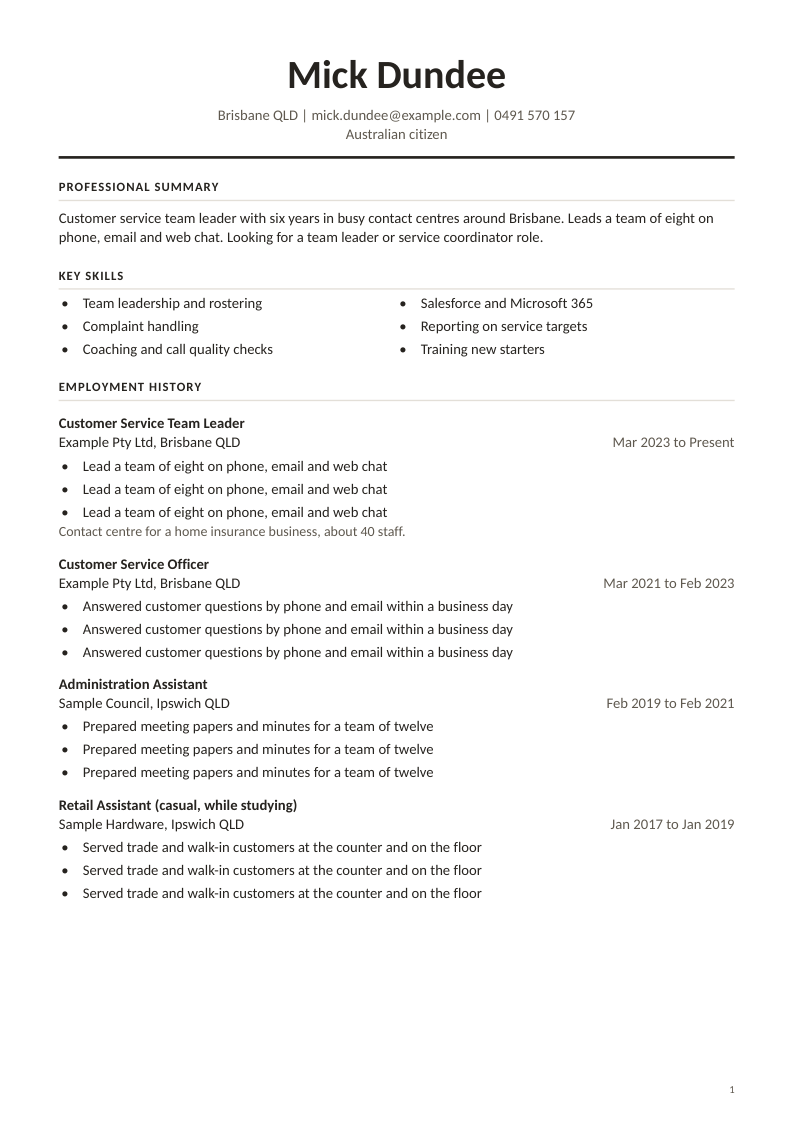
Righto, here's why it works:
- The work rights line states your status once, near your contact details.
- The latest job opens with 1 line that sets the scene.
- The results are real and plain, with no puffed-up numbers.
- Tickets and licences are easy to find.
- Each referee says how they know Mick.
On A4 at 11 point, it runs to 2 pages.
Build a resume Check my resume free
Going for a government job?
Government jobs often want more than a resume, so read the job pack. If it asks for a 1 or 2 page "statement of claims" against the selection criteria, write one. It gets marked just as hard as your resume, so don't knock it up on the back of a coaster. Send every document they ask for, including your cover letter.
What mistakes do we see a lot?
- A 1-page American resume that leaves out the detail Aussie recruiters want.
- American spelling. It also misses exact word matches with the job ad.
- A photo, your age or your date of birth.
- No work rights line when you're on a visa.
- Tables and text boxes, which some software can't read.
- Writing "References" where Aussies say "Referees".
- Listing referees who don't know they're on there.