New to Aussie resumes? Start with the Australian resume format guide. It walks you through the section order, the details to skip and a full worked example.
Leaving the Australian Defence Force means writing your service for a reader who has never worn a uniform.
Your service record holds plenty a civilian employer wants. The trick is saying it in their words. "Cpl" on its own is like a label on an esky that doesn't say what's in it. Below you'll find the government's resume advice for veterans, a word list to adapt and made-up before-and-after lines for a warehouse supervisor job.
What goes in an ADF-to-civilian resume?
The Veteran Employment Program sets out the sections it expects.[1] They match what any Australian employer wants, with a few military touches.
| Section | What the page says to put in it |
|---|---|
| Personal details | Name, email address, phone number with voicemail, and your level of security clearance |
| Introduction | A brief paragraph that sums up your main skills and experience, pitched at the role on offer |
| Work history | Most recent position first. Include the different positions you held in your military career, the dates and a brief description of the responsibilities. Add relevant volunteer roles |
| Education and training | Highest qualification first. Give the full name, the institution that awarded it and the date finished |
| Referees | At least 2 for every application, ideally people you reported to in your recent positions |
On referees, the page says to ask permission before you name anyone, and that "Referees: available on request" is fine if you want to protect their privacy.[1]
The same page says to tailor the resume to each job and show your achievements as well as your duties.
How long should an ADF-to-civilian resume be?
The Veteran Employment Program's Resume Writing page describes a resume as "a short (1-2 pages) document".[1] Our Australian resume format guide says most Australian resumes run 2 to 4 pages once you have work behind you. Two pages fits both, so aim for 2.
Go past 2 only when a long career has more relevant roles than 2 pages can hold. The same page tells you to consolidate information wherever possible, which keeps you near 2.
How do you turn rank and trade into civilian skills?
The Veteran Employment Program calls translating ADF-specific capabilities into civilian skills one of the hardest parts of writing a resume.[1] It offers a free tool for the job, the Core Skills Identifier.
You pick your rank from a list and the tool shows your skills "in terms that read well on a civilian resume". The page adds that these skills sit on top of any specific training you hold.[2] For a Corporal or Bombardier, the first line reads "Lead & manage small teams to achieve workplace goals & tasks".[2] Every rank has its own list.
To use the list:
- Open the Core Skills Identifier and choose your rank.
- Copy the lines into a scratch document.
- Cross out any line the job ad does not ask for.
- Rewrite what is left as a bullet under the matching role, with a number and a result from your own record.
Defence also publishes training and skills guides, grouped by rank for Navy, Army and Air Force. They put the skills gained in service in civilian language, match training and skills to rank, and give examples of civilian wording for a resume.[3]
Which service words should you swap?
These lists are our own suggestions. Treat them like a tucker box: take what suits the job and leave the rest. Check each against your rank's skills list and your own record. Service jargon changes between Navy, Army and Air Force, and between units.
Responsibilities, in civilian terms
| Service wording | Civilian wording |
|---|---|
| Commanded a section of eight | Supervised a team of eight |
| Commanded a platoon of 30 | Managed 30 staff through three team leaders |
| Second in command of the troop | Deputy to the manager. Ran the team when the manager was away |
| Wrote and issued orders for an exercise | Planned a multi-day field operation and briefed the crew on their tasks |
| Mentored junior members | Coached new starters and tracked their performance |
| Ran the unit stores | Managed inventory and stock records for a [number]-person team |
| Maintained platform and equipment | Serviced and kept records for [type of equipment], to schedule |
| Deployed on operations | Worked away from home for [number] months in a team of [number], under strict safety and security rules |
| Ran unit physical training | Designed and led fitness sessions for [number] people |
The square brackets mark where your own figures go. Use real numbers from your record, and leave a bracket out if you have no figure for it.
Which jargon and acronyms should you drop?
Jargon to drop
| Drop this | Write this |
|---|---|
| Posted to | Moved to the role of, then the role title |
| Tasking | Assignment, or the task itself |
| Sitrep | Status report |
| The unit, the squadron, the ship | Its size and function, such as "a 120-person logistics team" |
| Duty officer | After-hours on-call supervisor |
| In accordance with unit orders | To written procedures |
| PMKeyS number | Leave it off the resume |
Acronyms to spell out
| Acronym | Write |
|---|---|
| ADF | Australian Defence Force, then the Navy, Army or Air Force you served in |
| OIC | Officer in charge, then say what you were in charge of |
| 2IC | Second in command, or deputy |
| NCO | Non-commissioned officer, or simply supervisor |
| SOP | Standard operating procedure |
| PT | Physical training |
| HQ | Head office, or the name of the headquarters if the employer will know it |
Keep your rank and service in your work history, spelt out, in brackets after the role if you like, such as "Stores Supervisor (Corporal, Australian Army)". The reader is hiring for a role, so the role comes first.
What about security clearance and classified information?
The Veteran Employment Program lists your level of security clearance under personal details.[1] A clearance is a condition of some jobs, and employers that need one check it after they choose you. Put it with your contact details as a plain fact, and keep it out of your summary and skills.
Give the level only if you hold it, and say whether it is still active. A clearance needs a sponsoring employer, and AGSVA says one without a sponsor is made inactive and may be cancelled.[6]
The page also advises dropping any detail that has no link to the work you are going for.[1] A long list of courses, postings and awards from 10 years ago can go.
Check yours before a recruiter does.
Upload your resume and see what the hiring software reads. It's free.
Check my resume freeWhat do before-and-after lines look like?
These lines are a made-up example, written for a made-up job ad. They come from nobody's real record. Suppose the ad says:
| Before (service wording) | After (civilian wording) |
|---|---|
| Experienced NCO with 12 years' service in the Army seeking a new challenge in a dynamic environment. | Stores supervisor with 12 years in military supply, most recently running a six-person store and its stock records. Looking for a warehouse supervisor role. |
| CPL, Sup Pl, Log Coy. 2IC then OIC Q store. Mar 2019 to Dec 2023. | Stores Supervisor (Corporal, Australian Army). Mar 2019 to Dec 2023. Deputy, then manager, of a store holding supplies for a 120-person logistics team. |
| Conducted stocktakes IAW unit SOPs. | Counted stock each quarter against written procedures and cleared every variance. |
| Supervised junior pers during field exercises and ensured WHS compliance. | Supervised six new team members at remote sites and ran a safety briefing before each shift. |
Each change in the right-hand column does a job:
- It uses the ad's own words: "stock records", "safely" and "supervise".
- It gives a team size, so the reader can picture the scale.
- It spells out every acronym.
- It drops "dynamic environment", which says nothing a reader can check.
- It keeps the rank, in brackets, after the role.
What does the finished resume look like?
Mick Dundee is our made-up customer service team leader in Brisbane. He has no military history, so his resume carries no service lines. It shows the layout your service roles drop into, in place of his jobs.
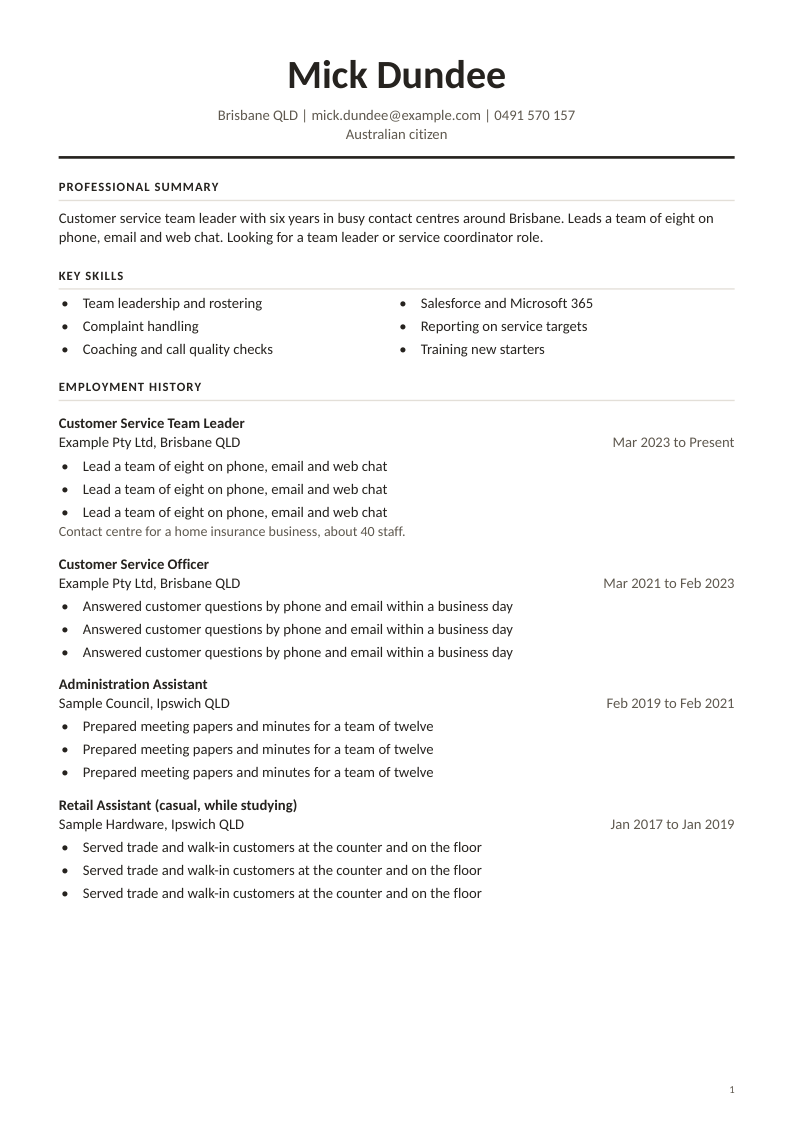
Righto, so why does it work? It packs like a well-rolled swag, with everything you need and nothing rattling around:
- The summary names the job Mick wants.
- The latest job opens with 1 line that sets the scene.
- Each bullet says what he did, and the results are plain.
- Tickets and licences are easy to find.
- Each referee says how they know him.
Build a resume Check my resume free
Do your service qualifications count?
Defence runs ADF Transition and Civil Recognition, which lets transitioning members, and those who left within 24 months, have skills recognised through recognition of prior learning (RPL). Trade qualifications go through a separate process.[3]
The Core Skills Identifier page points to the Australian Defence College for more on core skills and RPL.[2] Check the Defence page for the current rules before you apply.
Where can you get free help first?
- The Defence Force Transition Program can help you prepare a resume.[1] Defence also lists a Job Search Preparation Workshop that covers building a resume.[4]
- YourCareer, an Australian Government site, offers tips and checklists to improve a resume.[1][5]
- The Resume Writing page suggests asking a mentor and a non-ADF contact to read your draft.[1]
What mistakes should you check for before you send it?
- Acronyms the reader has to decode.
- A rank where a role title belongs.
- Any classified information.[1]
- Every course, posting and award, whether or not it suits the job.
- One resume sent to every employer. The government page asks for a tailored one each time.[1]
- A list of duties with no achievements.[1]
- Naming referees who have not agreed to it.[1]
Quick answers for ADF members
How many pages should a service resume run to?
Aim for 2 pages. The Veteran Employment Program describes a resume as a short document of 1 to 2 pages and advises consolidating information wherever possible. Our format guide allows up to 4 pages for a long career, so go past 2 only when every extra role suits the job.
Should I put my rank on a civilian resume?
Lead with the work you did and put your rank beside it if it helps. The Veteran Employment Program says to include the different positions you held across your military career and to translate ADF jargon into language a civilian employer understands.
Can I put my security clearance on my resume?
If you hold one, yes. The Veteran Employment Program lists your level of security clearance under personal details. Give the level and whether it is still active, and keep it out of your summary and skills. Classified information cannot go on a resume.
Where do I find civilian wording for my rank?
Use the Core Skills Identifier on the Veteran Employment Program site. Choose your rank and it lists your skills in terms that read well on a civilian resume. Defence also publishes training and skills guides grouped by rank.
Where can I get resume help through Defence?
The Veteran Employment Program says the Defence Force Transition Program can help with preparing a resume. Defence also runs a Job Search Preparation Workshop that covers building a resume.
Sources
- Veteran Employment Program: Resume Writing (opened 20 Nov 2026)
- Veteran Employment Program: Identify your skills, the Core Skills Identifier (opened 20 Nov 2026)
- Defence: Military skill recognition, including recognition of prior learning and the training and skills guides (opened 20 Nov 2026)
- Defence: Employment assistance for transitioning members (opened 20 Nov 2026)
- YourCareer, linked from the Resume Writing page (opened 20 Nov 2026)
- AGSVA: Reporting changes, changing employer and sponsorship (opened 20 Nov 2026)