New to Aussie resumes? Start with the Australian resume format guide. It walks you through the section order, the details to skip and a full worked example.
An ACT Public Service application usually has a resume, a written response that works as a personal pitch, and 2 referees.
The ACT Government hires through Jobs ACT, and each ad sets its own rules. Further down is Mick Dundee, a Kambah intake officer, with his resume and a sample response. Commonwealth jobs use APSjobs, which this page doesn't cover.
What is Jobs ACT and how do you submit an application?
Jobs ACT at jobs.act.gov.au is the ACT Government's careers site for ACT Public Service roles. Its How we hire section covers eligibility, preparing and submitting an application, selection processes and offers, and it links to opportunity alerts.[9]
Each ad's How to Apply section says where and how to send your application.[3] Treat it like the note stuck on the fridge. Whatever it says goes.
What else the official pages say about submitting:
- Save your written response, resume, referee reports and supporting documents as Word, PDF or Rich Text Format.[3]
- An online submission should bring an automatic acknowledgement email. If none arrives, call Shared Services on the number listed on the Jobs ACT submit page. An application sent straight to a contact officer isn't auto-receipted.[3]
What does an ACT government job application need?
Every ad sets its own list, like a bring-a-plate invite that says what to bring. Read it before you start cooking, mate. The applicant information kit says an ad may ask for a written application or personal pitch, a resume or curriculum vitae, referee contact details and supporting documents such as referee reports or copies of qualifications, registrations or licences.[1]
- Written response. The kit calls it a 1 to 3 page personal pitch, with the length set by the ad. The panel assesses it against the capabilities in the position description, and the kit asks for specific, evidence-based examples.[1] Jobs ACT adds that a criteria response is a formal report with each criterion numbered, while a pitch is a conversational letter without headings, and some ads ask set questions instead.[2]
- Resume. Current contact details, education, employment history and achievements.[1] The Australian resume format guide has the section rules, and the ATS-friendly resume guide covers layout that software reads cleanly.
- Referees. 2 professional referees, including a current manager where possible, each with a name, phone number, email address and a line on how you know them.[1]
Is there a word limit, and what happens after you apply?
Jobs ACT sets no general word limit that we could find, and it says some ads name a maximum length.[2] If you lack direct experience, it suggests outlining transferable skills.[2] Customer service work counts for heaps, and the retail resume guide shows how to write it up.
After the closing date the selection committee chooses its methods, which can include interviews, practical exercises and referee reports.[5]
What is the ACTPS Shared Capability Framework?
The framework describes the skill, knowledge and behaviour expected of ACT public servants at different levels. It has 5 domains: service delivery, teamwork, achieving results with integrity, thinking and innovating, and leadership.[6] The first 4 are each split into 3 streams, and every stream is described at 4 levels: team member, team leader, manager or specialist, and executive. Leadership stands alone, with no streams or levels.[7]
The levels add up, so a manager is expected to show what the levels below also describe.[7]
The values come with it. The kit says every ACT public servant is expected to embody respect, integrity, collaboration and innovation, along with the related signature behaviours.[1]
Your position description is the better guide. This page sums up the framework itself and quotes none of its descriptors.
How does the framework shape your answers?
A Canberra roundabout has plenty of exits and each trip uses only 1 or 2 of them. The framework works the same way. Your position description picks out the capabilities the job needs, and the kit says the panel assesses you against those.[1]
Read the criteria, spot which domain each one belongs to and give a real example for it.
Which checks apply to ACT government jobs?
Your ad or position description says which checks apply to your role. The official pages name these.
| Check | What the official pages say |
|---|---|
| Police and criminal history | The application form asks about relevant police records, reportable conduct or criminal history. Spent convictions do not need to be disclosed. Successful applicants who are new to the ACT Public Service complete a national criminal history check.[4] |
| Misconduct | You must disclose current or previously upheld allegations or investigations of misconduct.[4] |
| Working with Vulnerable People registration | Access Canberra runs the scheme. You need a registration if you will have more than incidental contact with vulnerable people in a regulated activity, and some exemptions apply. Not all paid and volunteer roles working with vulnerable people need one, and working in a regulated activity without registration is an offence.[8] |
| Referees and licences | Referees are contacted if you are in contention. If the ad lists a licence or registration, say you hold it and be ready to show the original.[1] |
The ad or position description says whether your role needs a Working with Vulnerable People registration. Access Canberra says to check before applying for one.[8]
How do you respond to a selection criterion?
Here's the short version. No worries if you have never done one.
An unbacked claim is like a letter addressed only to "Canberra". Nobody can find what you're offering. A real example with a date and a figure is the address.
The kit offers the STAR model of situation, task, action and result.[1] Here's how to use it, step by step.
- Find the capability the criterion points to in the position description, and note the level it sits at.
- Pick a single example from paid work, volunteering or study that shows that capability.
- Situation and task: a sentence or two on the setting and your part in it.
- Action: the steps you took yourself, written with “I”.
- Result: what changed afterwards, counted if you can.
What does an ACT government resume and criterion response look like?
He is applying for an administration role.
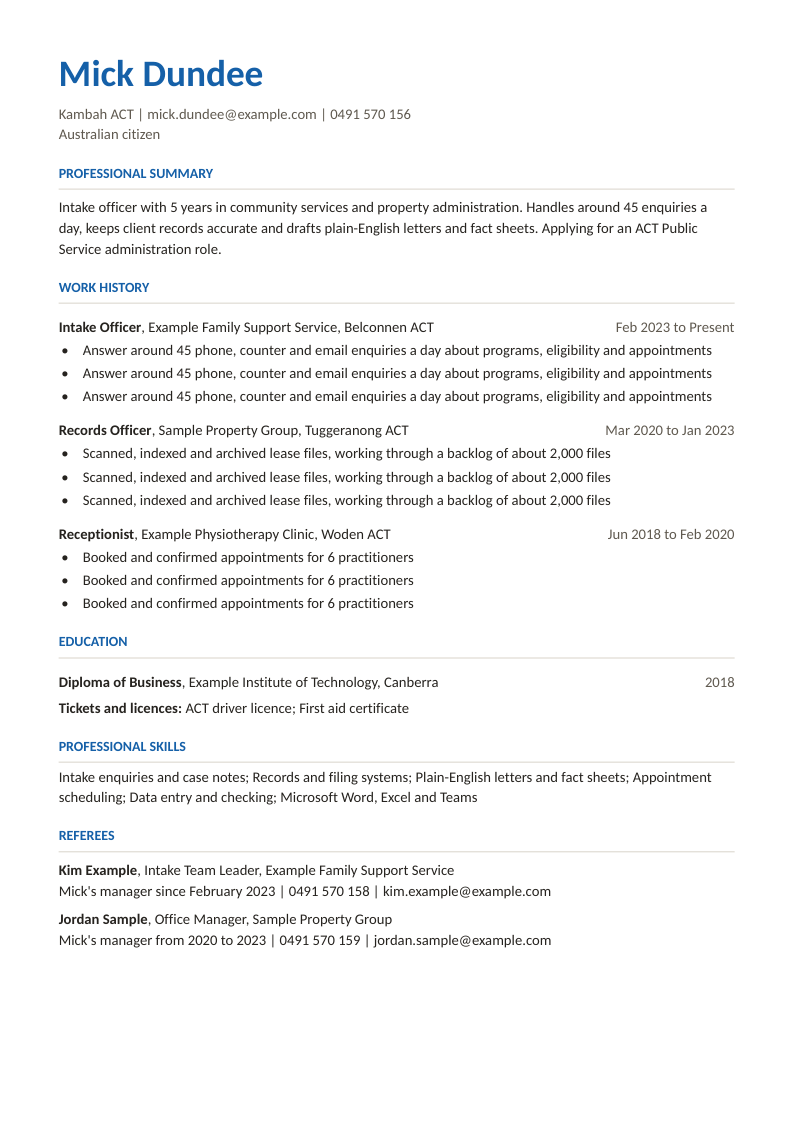
Next is a criterion with a short illustration of Mick's response.
Criterion (invented): Delivers a responsive service to clients and looks for ways to improve it.
Mick's response (invented): In March 2026 our service was getting about 20 calls a week from people confused by the intake form. As the intake officer who took most of those calls, I rewrote the fact sheet in short sentences and asked 2 new volunteers to test it. Over the next 2 months repeat calls about the form dropped by about a third.
Like a good pocketknife, it does one job well. Mick sticks to a single example, says what he did himself and finishes with a count.
Build a resume Check my resume free
How should a public service resume be laid out?
Keep the layout plain. Start with your name and contact line, then a summary of up to 4 lines that names the role, your closest experience and a result a panel can check.
Experience comes next, with each job set out the same way: title, employer, dates, then duties with their results in numbers where you can. Finish with education, skills taken from the position description and 2 referees.
Put your work rights on a line of their own only if the ad asks, and order the sections to suit the ad.
Check yours before a recruiter does.
Upload your resume and see what the hiring software reads. It's free.
Check my resume freeWho can apply for an ACT government job?
Requirements differ between roles, so the ad is the final word. Jobs ACT says you must hold a current Australian visa that includes work rights, or be an Australian citizen or permanent resident. New Zealand citizens living in Australia on a Special Category visa are treated as permanent residents for ACT Public Service eligibility only.[4]
A security clearance is required only for some positions, as the position description states. The Australian Government Security Vetting Agency handles vetting for the Territory.
You don't need a clearance to apply, but you must be eligible and willing to be vetted, and employment may depend on it. Clearance eligibility generally requires Australian citizenship and a checkable background. Some roles require citizenship.[4]
When the ad asks for it, put your status, such as “Australian citizen”, on a line below your contact details. The role sets it as a condition. The panel assesses you against the capabilities in the position description.
The kit says the service is committed to reasonable adjustment for people with disability or injury.[1] If you need adjustments, tell the contact officer in the ad.
Quick answers
Where do I find ACT government jobs?
Jobs ACT at jobs.act.gov.au advertises ACT Public Service roles. Each ad has a How to Apply section that says what to send and where.
Do I have to address the selection criteria?
If the ad asks for it, yes. Jobs ACT describes a criteria response as a numbered report that follows the order of the position description. Some ads ask for a personal pitch or set questions instead.
How long should my written response be?
The applicant information kit describes a 1 to 3 page personal pitch, with the length set by the ad. Some ads name a style or a maximum length, so check yours.
Which checks can I expect for an ACT government job?
Successful applicants who are new to the ACT Public Service complete a national criminal history check. Other checks depend on the role, such as a Working with Vulnerable People registration or a security clearance.
Do I need Australian citizenship for an ACT government job?
Not always. Jobs ACT says you need a current visa with work rights, or to be an Australian citizen or permanent resident. Some roles require citizenship, so check the ad.
Sources
- Jobs ACT: applicant information kit (PDF), March 2026, checked 20 Nov 2026
- Jobs ACT: prepare your application, checked 20 Nov 2026
- Jobs ACT: submit your application, checked 20 Nov 2026
- Jobs ACT: eligibility to apply, checked 20 Nov 2026
- Jobs ACT: selection processes, checked 20 Nov 2026
- ACT Government (CMTEDD): ACTPS shared capability, page updated 29 Jun 2026, checked 20 Nov 2026
- ACT Government (CMTEDD): ACTPS Shared Capability Framework (PDF), July 2017, checked 20 Nov 2026
- Access Canberra: Working with Vulnerable People scheme, checked 20 Nov 2026
- Jobs ACT: home page and How we hire, checked 20 Nov 2026