New to Aussie resumes? Start with the Australian resume format guide. It walks you through the section order, the details to skip and a full worked example.
A Western Australian government application has its own moving parts. Here is the order to tackle them in.
WA government jobs are advertised on 1 search site, but each agency runs its own application. You search in one place, click Apply Now and land somewhere else, with a different form and rules.[1] The job ad always wins.
Where do you find and apply for WA government jobs?
The search site is JobsWA, which the site itself calls WA Government Jobs, at search.jobs.wa.gov.au. You can search, apply and look up an earlier application without registering.[1] Registering lets you save favourite jobs, set up job alerts and manage devices. An alert emails you each weekday with new jobs that match your options.[1]
The WA Jobs and Workforce Hub at jobs.wa.gov.au has the advice pages.[3]
Apply Now takes you out of JobsWA and into the application system of the agency that advertised the job. Applications to different agencies can therefore sit in different systems, so keep each confirmation email.[1][2]
JobsWA works like a fingerpost at a bush crossroads. It points you to the right town, and the paperwork gets done when you arrive.
What does a WA government application contain?
It depends on the agency and the ad. The WA jobs hub says requirements differ, so read the whole ad for word limits, fonts and deadlines, and look for a downloadable application pack.[3] It also says some jobs want just a cover letter that addresses a few criteria, while others want every criterion addressed.[3] An agency's applicant page lists 3 shapes: a resume only, a resume with responses to the role requirements, or a resume with answers to specific questions.[4]
The criteria usually live in the job description form, a document linked from the ad.[3][4] Treat it like the afternoon sea breeze in Perth. The Fremantle Doctor decides how the arvo goes, so locals check for it before they plan anything, and you should read the form before you write a word, mate.
The pages read for this guide don't mention a pitch format. If an ad asks for one, follow the ad.
Your resume still follows the standard Australian layout in the format guide. The ATS-friendly guide covers screening software. Some ads run a pool, where a process finds a number of suitable people who may be appointed to later jobs. A pool generally runs for 6 to 12 months.[3]
What do the WA capability and leadership frameworks cover?
The Public Sector Commission publishes 2 frameworks that sit behind many criteria. The Commission's copyright terms for Leadership Expectations limit how that text can be reused, and the capability profiles page states no licence, so this guide describes both in its own words and links to the originals.[8]
The capability profiles, published in 2020, rest on 5 core competencies. In short they cover setting direction, getting results, working with people, acting with integrity and self-awareness, and communicating and influencing. One profile covers levels 1 to 6 and a second covers level 7 to class 4.[7]
Leadership Expectations is the newer material, updated in 2023. It describes behaviours and mindsets for 7 leadership contexts. The first is personal leadership, for staff who don't hold a leadership role yet. The ladder then climbs through leading others, leading leaders and leading several business areas, up to executive, agency and statewide leadership.[6]
Agencies aren't bound to copy either one. The Commission says the behaviours in this material are a guide, and agencies decide which of 5 suitability areas get criteria and describe each requirement for the position.[5] So answer the criteria as the ad words them, mate. The WA jobs hub says those criteria are used to choose the best person for the job.[3]
What checks happen before you start?
The Public Sector Commission says pre-employment checks are carried out after suitable applicants have been identified, to confirm they can be lawfully, safely and appropriately appointed. It lists a National Police Clearance, a Working with Children check, a statutory declaration and medical checks.[5] Its examples of pre-employment conditions also include integrity screening and a security clearance.[5] Which of these apply depends on the role, so check the ad.
The Working with Children Check in WA is run by the WWC Screening Unit in the Department of Communities under the Working with Children (Screening) Act 2004. Organisations must not engage someone in child-related work without a current card or a pending application.[9]
How do you respond to a selection criterion?
Pick 1 real example per criterion and write it in 4 short moves. The WA jobs hub gives the same basic advice: use a relevant example, describe the context, describe your action in the first person and name the outcome.[3] Righto, here's the version we use.
- Read the criterion and work out what it's really asking for.
- Choose the example. A recent one that you led is best.
- Say what you did and why you chose to do it. Use "I" for your own actions.
- Finish with the result, with a number or a comment you received if you have one.
Back each claim with an example. A claim on its own is a billy with no water, and it won't make a brew for the panel. Some ads set word or page limits, so keep the example short.
Ring the contact person in the ad if you're unsure what the panel wants. No worries if ringing feels nervy. Keen applicants do it.
What does a WA government application look like?
Mick Dundee works at a public library in Joondalup and is going for a Level 3 administration officer job with a WA agency. The ad links a job description form and asks for a resume and written responses to the criteria. First comes his resume, and after it 1 criterion response.
The ad lists its criteria one by one, so he answers them one by one, like a bakery order with a line for every loaf.
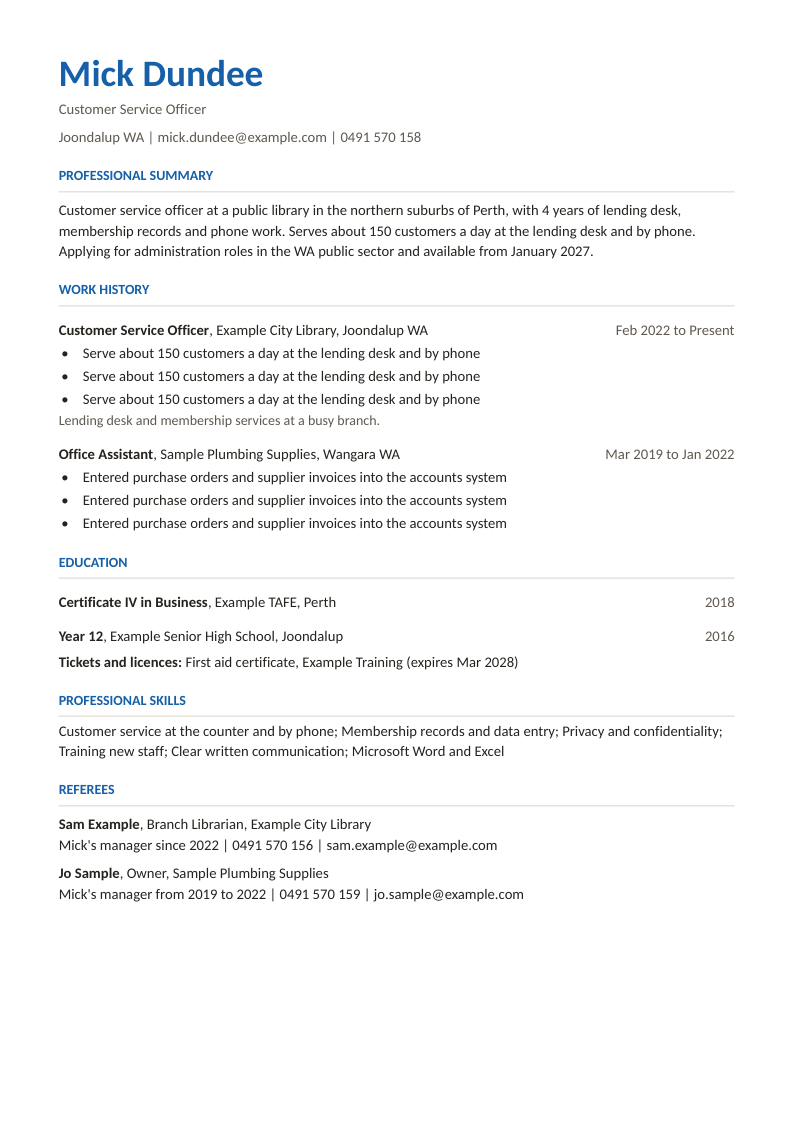
Here's 1 invented criterion and response. The criterion wording is made up and isn't from any real form.
Criterion (invented): Communicates clearly and builds productive working relationships with colleagues and the public.
When I joined the library branch in 2022, the lending desk and the stack team passed requests by sticky note, and about 10 a week came back with details missing. I invited both teams to a 15 minute meeting, drafted a 1-page handover sheet with them and agreed who confirms each return. After 3 months both teams used the sheet for every request and hand-backs fell to 2 a week.
Why it works:
- It names 1 situation and keeps to it.
- The actions are Mick's own, so the panel can see what he did.
- The result is a working arrangement with another team, and the hand-back count matches his resume.
Build a resume Check my resume free
Check yours before a recruiter does.
Upload your resume and see what the hiring software reads. It's free.
Check my resume freeWho can work in the WA government sector?
The WA jobs hub says you must be an Australian citizen, hold permanent resident status in Australia, or have a visa that allows you to live and work in Australia for the period of your employment contract.[3] Some jobs list other conditions. The hub suggests mentioning in your application any that you meet, or in the portal questions.[3]
WA law allows some jobs to be designated for people of a certain race, sex, disability or age. An example is a job open only to Aboriginal and Torres Strait Islander people. These are sometimes called 50(d) positions, and the ad and job description say so clearly.[3] If you need a reasonable adjustment to take part in selection, an agency asks you to tell the panel.[4]
Who should you list as referees?
An agency's applicant page asks you to identify 2 referees who can speak to your skills, experience and capabilities.[4] Other ads may ask for a different number.
Mick named his current manager and his previous one. Ask each person before you list them, even if it feels cheeky, because a referee who gets a surprise call is like a neighbour asked to water a garden he has never seen. Keep their phone and email in the resume text, as the example does.
Quick answers
Where are WA government jobs advertised?
On JobsWA, at search.jobs.wa.gov.au. Apply Now takes you to the application system of the agency that advertised the job.
Do I need an account to apply on JobsWA?
No. You can search, apply and find a previous application without registering. An account lets you save favourite jobs and set up job alerts.
Do I have to address the selection criteria?
Your agency and the ad decide. The WA jobs hub says some jobs want a cover letter that addresses a few criteria and others want every criterion addressed. One agency lists a resume only, a resume with responses to the role requirements, or a resume with answers to set questions. The ad says which.
Who can apply for a WA government job?
You must be an Australian citizen, a permanent resident, or hold a visa that lets you live and work in Australia for the period of your employment contract.
What checks happen before I start?
The Public Sector Commission lists a National Police Clearance, a Working with Children check, a statutory declaration and medical checks. Which ones apply depends on the role.
What is a talent pool or appointment pool?
A process finds a number of suitable people who may be appointed to future jobs. A pool generally runs for 6 to 12 months.
Sources
- WA Government Jobs (JobsWA): help, checked 20 Nov 2026
- WA Government Jobs (JobsWA): find my applications, checked 20 Nov 2026
- WA Jobs and Workforce Hub: applying for a job in WA's government sector, checked 20 Nov 2026
- WA Government: careers, information for applicants (Department of Mines, Petroleum and Exploration), updated 1 Jul 2025, checked 20 Nov 2026
- Public Sector Commission (WA): Recruiting, Selecting and Appointing, Suitability Requirements, checked 20 Nov 2026
- Public Sector Commission (WA): Leadership Expectations, updated 22 Sep 2023, checked 20 Nov 2026
- Public Sector Commission (WA): Public Sector Capability Profiles, updated 30 Jun 2020, checked 20 Nov 2026
- Public Sector Commission (WA): copyright statement for Building Leadership Impact and Leadership Expectations, updated 5 Oct 2023, checked 20 Nov 2026
- Department of Communities (WA): what is the Working with Children Check, updated 20 Aug 2026, checked 20 Nov 2026